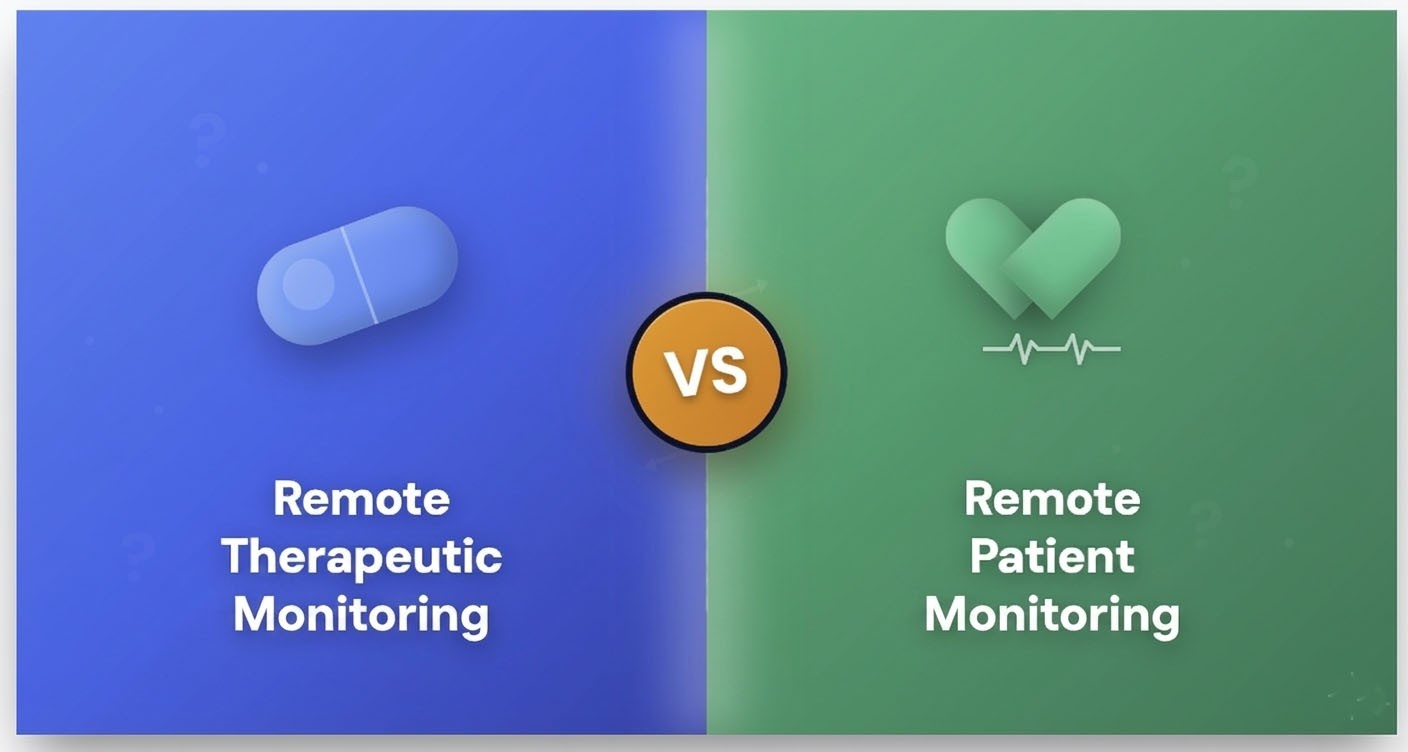
RTM vs RPM: Understanding the Difference and Why You Need Both

Tushar Kumar M.D., MBA
Tushar Kumar M.D., MBA
If you're in healthcare leadership, you've likely heard both "RTM" and "RPM" mentioned in the same breath. While they sound similar and both involve remote monitoring, they serve fundamentally different purposes. Understanding this distinction is critical for implementing the right solution for your patient population, and for maximizing reimbursement.
What's New for 2026: CMS has significantly expanded RTM billing opportunities, making it easier and more profitable to monitor therapeutic compliance. This guide reflects all 2026 changes.
The Core Difference
Remote Patient Monitoring (RPM) tracks physiological data:
Blood pressure readings
Heart rate and oxygen saturation
Weight measurements
Blood glucose levels
Temperature
Remote Therapeutic Monitoring (RTM) tracks therapeutic compliance and response:
Medication adherence (doses taken vs. missed)
Self-reported symptoms
Therapy compliance (physical therapy exercises, respiratory therapy)
Treatment response data
Pain scales and functional assessments
The key insight: RPM tells you what's happening in a patient's body. RTM tells you what the patient is doing about it.
A Real-World Scenario
Consider Mrs. Johnson, a 72-year-old with congestive heart failure, diabetes, and hypertension. She takes 11 medications daily.
With RPM only:
You see her blood pressure is 165/95 (elevated)
Her weight increased 4 pounds this week
Her blood glucose is trending upward
What you don't know:
Did she take her blood pressure medication today?
Has she been skipping her diuretic?
Is she taking her diabetes medications as prescribed?
With RTM added:
You discover she's been missing her evening medications 40% of the time
She skipped her diuretic 3 times this week
Her morning diabetes medication adherence is 95% but evening is only 60%
Now you can intervene effectively: The problem isn't that her conditions are worsening, it is that she's not taking her medications consistently. A quick nursing call reveals she forgets her evening doses when her routine changes. You adjust her reminder schedule, and within two weeks, her adherence improves to 92% and her vitals stabilize.
CPT Codes & Reimbursement (2026 Rates)
RPM Codes:
CPT 99453: Initial setup and patient education (~$20)
CPT 99454: Device supply with daily recording (~$64/month)
CPT 99457: First 20 minutes of clinical staff time (~$52)
CPT 99458: Each additional 20 minutes (~$42)
Requirements:
16 days of data transmission per month
At least 20 minutes of interactive communication
RTM Codes (Updated for 2026):
The codes would cover: Medication adherence monitoring (like LynxFlow does), Physical therapy exercise compliance, Rehabilitation tracking, Pain management therapy, Self-management programs, Treatment response monitoring
Setup & Education:
CPT 98975: Initial setup and patient education ($21.71)
One-time fee per episode of care
Can be performed by clinical staff
Device Supply - NEW LOWER THRESHOLD:
CPT 98985: device supply, 2-15 days ($40.08/month) (NEW for 2026)
Previously, patients needed 16 days to bill anything
Now you can bill for short-term or episodic monitoring
Perfect for post-discharge, trial periods, mid-month enrollments
CPT 98977: device supply, 16-30 days ($40.08/month)
Clarified from "16+ days" to specific range
Standard billing for ongoing monitoring programs
Treatment Management - NEW LOWER TIME THRESHOLD:
CPT 98979: 10-19 minutes of clinical time ($26.39) (NEW for 2026)
Game changer: Previously minimum was 20 minutes
Now 15 minutes of clinical time is billable
Must include one real-time interactive communication
CPT 98980: 20-39 minutes of clinical time ($54.11)
Clarified from "20+ minutes" to specific range
Must include one real-time interactive communication
CPT 98981: Each additional 20 minutes ($41.42)
Bill after 98980 for high-intensity patients
Requirements (Updated):
Minimum 2 days of data transmission for 98985 (was 16 days)
Minimum 10 minutes of clinical time for 98979 (was 20 minutes)
At least one real-time interactive communication required (phone, video, in-person)
Critical difference: RTM doesn't require physiological monitoring devices. Medication adherence monitoring, symptom tracking via app, and therapy compliance all qualify.
Why the 2026 Changes Matter
More Patients Qualify:
Before 2026: If patient transmits data for 12 days, it would equate to $0 revenue
With 2026: If patient transmits data for 12 days, it would generate $66.47 revenue (98985 + 98979)
More Clinical Time is Billable:
Before 2026: If a nurse spends 15 minutes on RTM, it would equate to $0 revenue
With 2026: If a nurse spends 15 minutes on RTM, it would generate $26.39 revenue (98979)
Expanded Use Cases:
Post-discharge monitoring (2-3 weeks)
Trial/pilot programs (testing patient engagement)
Mid-month enrollments (partial month billing)
Brief clinical interventions (10-15 minute touchpoints)
When to Use Each
Use RPM when:
Patient has unstable vital signs requiring frequent monitoring
Recent hospital discharge with high readmission risk
Chronic conditions requiring physiological data (CHF, COPD, diabetes)
Provider needs to track disease progression
Documentation needed for value-based care metrics
Clinica Trials
At risk patient population (elderly, patients with dementia, or patients with psychiatric conditions) undergoing chemotherapy for cancer to monitor for toxicity
Use RTM when:
Medication adherence is a concern
Patient is on complex medication regimens (5+ medications)
Therapy compliance needs tracking (PT, respiratory therapy)
Self-management behaviors need monitoring
Treatment response assessment is needed
Short-term monitoring needs (post-discharge, acute episodes, oral chemotherapy)
Use BOTH when:
High-risk patients with multiple chronic conditions
Post-discharge transitional care
Patients with both physiological instability AND adherence concerns
Maximizing preventive intervention opportunities
The Business Case for Combining RPM + RTM (Taking into consideration 2026 Rates)
Let's look at the numbers for a 100-patient program:
RPM Alone (average reimbursement):
Setup: $2,000 (100 patients × $20)
Monthly device: $6,400/month ($64 × 100)
Clinical time: $5,200/month (avg $52 per patient)
Annual: $140,200
RTM Alone (2026 rates):
Setup: $2,171 (100 patients × $21.71)
Monthly device (mix of 98985/98977): $4,008/month ($40.08 × 100)
Clinical time (mix of 98979/98980): $4,025/month (avg $40.25 per patient)
Annual: $98,567
RPM + RTM Combined:
Can bill both for same patient (different modalities)
Setup: $4,171
Monthly device: $10,408
Clinical time: $9,225
Annual: $238,767
Plus documented cost savings:
Prevented readmissions: ~$200,000
Reduced ER visits: ~$50,000
Net benefit Year 1: ~$488,767
Per patient annual benefit: ~$4,888
2026 Billing Optimization Strategies
Strategy 1: Leverage New Short-Term Codes
Opportunity: 98985 opens up new revenue from previously unbillable patients
Example:
Post-discharge patient monitored for 2 weeks (10 days of data)
12 minutes of nursing time
Revenue: $66.47 (was $0 before 2026)
Extrapolate: 20 such patients/month = $15,948 annual
Strategy 2: Capture 10-19 Minute Interventions
Opportunity: 98979 captures clinical time that was previously lost
Example:
Review adherence data: 5 minutes
Brief phone check-in: 8 minutes
Total: 13 minutes - Now billable at $26.39
Before 2026: $0 (didn't hit 20-minute threshold)
Strategy 3: Risk Stratification for Maximum Efficiency
High-Risk Tier (30% of patients):
40-60 minutes monthly clinical time
Bill: 98977 + 98980 + 98981
Revenue: $135.61/month per patient
Medium-Risk Tier (50% of patients):
20-30 minutes monthly clinical time
Bill: 98977 + 98980
Revenue: $94.19/month per patient
Low-Risk/Short-Term Tier (20% of patients):
10-15 minutes monthly clinical time
Bill: 98985 + 98979
Revenue: $66.47/month per patient
Weighted Average Revenue per Patient: $106.76/month
Implementation Considerations
Technology Requirements
For RPM:
Connected devices (blood pressure cuffs, scales, glucometers)
Cellular connectivity or Bluetooth bridges
Device management platform
Integration with patient data systems that can provide analytics such as Lynxflow Health
For RTM:
Smart pill dispensers or medication tracking devices (supplied through Lynxflow health)
Mobile apps for symptom reporting
Two-way communication system
Adherence analytics platform
LynxFlow Health advantage: Our platform combines both, eliminating the need for multiple vendors and providing unified patient view with built-in 2026 compliance tracking.
Workflow Integration
RPM workflow:
Review physiological data dashboard
Identify out-of-range readings
Contact patients with abnormal values
Adjust treatment plans based on data
RTM workflow (optimized for 2026):
Review adherence reports and alerts
Identify patients with declining adherence
Proactive outreach before clinical deterioration
Document time to capture 10-19 minute interventions (NEW)
Investigate barriers to adherence
Combined workflow:
Single dashboard shows both vital signs and adherence
Correlate poor adherence with deteriorating vitals
Earlier intervention window
More targeted clinical conversations
Efficient time tracking for both RPM and RTM billing
Staffing Models
RPM requires:
Clinical staff (RN, LPN) to interpret vital signs
Protocol-driven response to abnormal values
Provider oversight and care plan adjustments
RTM requires:
Can be managed by care coordinators or nurses
Less intensive clinical interpretation
Focus on behavioral coaching and barrier identification
With 2026 changes: Even brief interventions are now billable
Combined approach:
Same staff can manage both
More complete patient picture
Better use of nursing time
2026 bonus: Lower time thresholds mean more billable encounters
Common Mistakes to Avoid (Updated for 2026)
Mistake #1: Not leveraging new short-term codes
Problem: Continuing to require 16 days before enrolling patients
Solution: Use 98985 for short-term monitoring (2-15 days) Impact: Missing 15-20% additional revenue opportunity
Mistake #2: Not documenting 10-19 minute interventions
Problem: Only billing when hitting 20 minutes
Solution: Use 98979 for brief but valuable clinical touchpoints Impact: Leaving $26.39 on the table per interaction
Mistake #3: Billing both 98985 (device supply 2-15 days) and 98977 (device supply 16+ days) in same period
Problem: Violates CPT guidelines
Solution: Choose one based on total days transmitted Impact: Claim denials and audit risk
Mistake #4: Ignoring adherence data
Having RPM data showing worsening vitals while ignoring that the patient is not taking medications is treating symptoms instead of root causes.
Mistake #5: Separate platforms
Using different vendors for RPM and RTM creates fragmented data, duplicate workflows, and frustrated staff.
Mistake #6: Not billing for both
If you're doing both RPM and RTM activities, you should bill for both. They're separate CPT codes for a reason.
Mistake #7: Poor patient selection
Not every patient needs both. Use risk stratification to identify who benefits most from combined monitoring.
Mistake #8: Not having a knowledgeable partner for workflow implementation, quality assurance, EHR integration, and Analytics
Solution: Partner with Lynxlow Health
Patient Selection Framework (2026 Updated)
RPM only candidates:
Physiologically unstable
Good medication adherence
Recent device implant requiring monitoring
Conditions primarily managed by vital sign tracking
RTM only candidates:
Stable vitals
Complex medication regimens
History of non-adherence
Conditions primarily managed by medication
NEW: Short-term post-discharge monitoring (2-3 weeks)
NEW: Trial candidates for long-term monitoring
RPM + RTM candidates:
Multiple chronic conditions
High readmission risk
Both physiological instability and adherence concerns
Post-discharge within 30 days
High-cost, high-utilization patients
2026 Documentation Requirements:
For 98985 (2-15 days):
· Document exact days of transmission (not just ">2")
· Must have documented monitoring plan
· Cannot bill both 98985 and 98977 in same 30-day period
For 98979 (10-19 minutes):
· Time documented to the minute (e.g., "12 minutes" not "10-15 minutes")
· Must include at least one real-time interactive communication
· Document what was discussed and clinical decisions made
· Cannot bill if total time <10 minutes
For Combined RPM + RTM:
· Separate documentation for each modality
· Time cannot be double-counted
· Different staff members can perform RPM vs RTM activities Both can be billed in same calendar month
The Future: Integrated Monitoring
The future of remote care isn't RPM vs. RTM, it is comprehensive remote care management that includes:
Physiological monitoring (RPM)
Therapeutic monitoring (RTM)
Social determinants of health screening
Predictive analytics
Automated intervention protocols
With the 2026 changes lowering barriers to RTM billing, integrated platforms that track both physiological data and therapeutic adherence are now more valuable than ever.
Conclusion
RPM and RTM aren't competing technologies, they are complementary tools that address different aspects of patient care. RPM tells you what is happening physiologically. RTM tells you what the patient is doing therapeutically. Together, they provide the complete picture needed for effective remote care management.
The 2026 changes make this combination more accessible and profitable than ever:
Lower thresholds mean more patients qualify
Shorter interactions are now billable
Greater flexibility in program design
Significant revenue expansion opportunity
The organizations seeing the best outcomes and highest ROI are those implementing both strategically, using unified platforms that provide clinicians with comprehensive patient data in a single workflow while maximizing the new 2026 billing opportunities.
Ready to implement comprehensive remote monitoring with 2026 optimization or have Questions about RTM vs RPM under the new 2026 rules? Email us at info@lynxflowhealth.com
Disclaimer: This guide reflects the CMS CY 2026 Medicare Physician Fee Schedule Final Rule (October 31, 2025). Billing regulations may vary by payer and region. Reimbursement rates are national averages. Consult with qualified billing professionals for specific situations.
Last Updated: December 31, 2025
If you're in healthcare leadership, you've likely heard both "RTM" and "RPM" mentioned in the same breath. While they sound similar and both involve remote monitoring, they serve fundamentally different purposes. Understanding this distinction is critical for implementing the right solution for your patient population, and for maximizing reimbursement.
What's New for 2026: CMS has significantly expanded RTM billing opportunities, making it easier and more profitable to monitor therapeutic compliance. This guide reflects all 2026 changes.
The Core Difference
Remote Patient Monitoring (RPM) tracks physiological data:
Blood pressure readings
Heart rate and oxygen saturation
Weight measurements
Blood glucose levels
Temperature
Remote Therapeutic Monitoring (RTM) tracks therapeutic compliance and response:
Medication adherence (doses taken vs. missed)
Self-reported symptoms
Therapy compliance (physical therapy exercises, respiratory therapy)
Treatment response data
Pain scales and functional assessments
The key insight: RPM tells you what's happening in a patient's body. RTM tells you what the patient is doing about it.
A Real-World Scenario
Consider Mrs. Johnson, a 72-year-old with congestive heart failure, diabetes, and hypertension. She takes 11 medications daily.
With RPM only:
You see her blood pressure is 165/95 (elevated)
Her weight increased 4 pounds this week
Her blood glucose is trending upward
What you don't know:
Did she take her blood pressure medication today?
Has she been skipping her diuretic?
Is she taking her diabetes medications as prescribed?
With RTM added:
You discover she's been missing her evening medications 40% of the time
She skipped her diuretic 3 times this week
Her morning diabetes medication adherence is 95% but evening is only 60%
Now you can intervene effectively: The problem isn't that her conditions are worsening, it is that she's not taking her medications consistently. A quick nursing call reveals she forgets her evening doses when her routine changes. You adjust her reminder schedule, and within two weeks, her adherence improves to 92% and her vitals stabilize.
CPT Codes & Reimbursement (2026 Rates)
RPM Codes:
CPT 99453: Initial setup and patient education (~$20)
CPT 99454: Device supply with daily recording (~$64/month)
CPT 99457: First 20 minutes of clinical staff time (~$52)
CPT 99458: Each additional 20 minutes (~$42)
Requirements:
16 days of data transmission per month
At least 20 minutes of interactive communication
RTM Codes (Updated for 2026):
The codes would cover: Medication adherence monitoring (like LynxFlow does), Physical therapy exercise compliance, Rehabilitation tracking, Pain management therapy, Self-management programs, Treatment response monitoring
Setup & Education:
CPT 98975: Initial setup and patient education ($21.71)
One-time fee per episode of care
Can be performed by clinical staff
Device Supply - NEW LOWER THRESHOLD:
CPT 98985: device supply, 2-15 days ($40.08/month) (NEW for 2026)
Previously, patients needed 16 days to bill anything
Now you can bill for short-term or episodic monitoring
Perfect for post-discharge, trial periods, mid-month enrollments
CPT 98977: device supply, 16-30 days ($40.08/month)
Clarified from "16+ days" to specific range
Standard billing for ongoing monitoring programs
Treatment Management - NEW LOWER TIME THRESHOLD:
CPT 98979: 10-19 minutes of clinical time ($26.39) (NEW for 2026)
Game changer: Previously minimum was 20 minutes
Now 15 minutes of clinical time is billable
Must include one real-time interactive communication
CPT 98980: 20-39 minutes of clinical time ($54.11)
Clarified from "20+ minutes" to specific range
Must include one real-time interactive communication
CPT 98981: Each additional 20 minutes ($41.42)
Bill after 98980 for high-intensity patients
Requirements (Updated):
Minimum 2 days of data transmission for 98985 (was 16 days)
Minimum 10 minutes of clinical time for 98979 (was 20 minutes)
At least one real-time interactive communication required (phone, video, in-person)
Critical difference: RTM doesn't require physiological monitoring devices. Medication adherence monitoring, symptom tracking via app, and therapy compliance all qualify.
Why the 2026 Changes Matter
More Patients Qualify:
Before 2026: If patient transmits data for 12 days, it would equate to $0 revenue
With 2026: If patient transmits data for 12 days, it would generate $66.47 revenue (98985 + 98979)
More Clinical Time is Billable:
Before 2026: If a nurse spends 15 minutes on RTM, it would equate to $0 revenue
With 2026: If a nurse spends 15 minutes on RTM, it would generate $26.39 revenue (98979)
Expanded Use Cases:
Post-discharge monitoring (2-3 weeks)
Trial/pilot programs (testing patient engagement)
Mid-month enrollments (partial month billing)
Brief clinical interventions (10-15 minute touchpoints)
When to Use Each
Use RPM when:
Patient has unstable vital signs requiring frequent monitoring
Recent hospital discharge with high readmission risk
Chronic conditions requiring physiological data (CHF, COPD, diabetes)
Provider needs to track disease progression
Documentation needed for value-based care metrics
Clinica Trials
At risk patient population (elderly, patients with dementia, or patients with psychiatric conditions) undergoing chemotherapy for cancer to monitor for toxicity
Use RTM when:
Medication adherence is a concern
Patient is on complex medication regimens (5+ medications)
Therapy compliance needs tracking (PT, respiratory therapy)
Self-management behaviors need monitoring
Treatment response assessment is needed
Short-term monitoring needs (post-discharge, acute episodes, oral chemotherapy)
Use BOTH when:
High-risk patients with multiple chronic conditions
Post-discharge transitional care
Patients with both physiological instability AND adherence concerns
Maximizing preventive intervention opportunities
The Business Case for Combining RPM + RTM (Taking into consideration 2026 Rates)
Let's look at the numbers for a 100-patient program:
RPM Alone (average reimbursement):
Setup: $2,000 (100 patients × $20)
Monthly device: $6,400/month ($64 × 100)
Clinical time: $5,200/month (avg $52 per patient)
Annual: $140,200
RTM Alone (2026 rates):
Setup: $2,171 (100 patients × $21.71)
Monthly device (mix of 98985/98977): $4,008/month ($40.08 × 100)
Clinical time (mix of 98979/98980): $4,025/month (avg $40.25 per patient)
Annual: $98,567
RPM + RTM Combined:
Can bill both for same patient (different modalities)
Setup: $4,171
Monthly device: $10,408
Clinical time: $9,225
Annual: $238,767
Plus documented cost savings:
Prevented readmissions: ~$200,000
Reduced ER visits: ~$50,000
Net benefit Year 1: ~$488,767
Per patient annual benefit: ~$4,888
2026 Billing Optimization Strategies
Strategy 1: Leverage New Short-Term Codes
Opportunity: 98985 opens up new revenue from previously unbillable patients
Example:
Post-discharge patient monitored for 2 weeks (10 days of data)
12 minutes of nursing time
Revenue: $66.47 (was $0 before 2026)
Extrapolate: 20 such patients/month = $15,948 annual
Strategy 2: Capture 10-19 Minute Interventions
Opportunity: 98979 captures clinical time that was previously lost
Example:
Review adherence data: 5 minutes
Brief phone check-in: 8 minutes
Total: 13 minutes - Now billable at $26.39
Before 2026: $0 (didn't hit 20-minute threshold)
Strategy 3: Risk Stratification for Maximum Efficiency
High-Risk Tier (30% of patients):
40-60 minutes monthly clinical time
Bill: 98977 + 98980 + 98981
Revenue: $135.61/month per patient
Medium-Risk Tier (50% of patients):
20-30 minutes monthly clinical time
Bill: 98977 + 98980
Revenue: $94.19/month per patient
Low-Risk/Short-Term Tier (20% of patients):
10-15 minutes monthly clinical time
Bill: 98985 + 98979
Revenue: $66.47/month per patient
Weighted Average Revenue per Patient: $106.76/month
Implementation Considerations
Technology Requirements
For RPM:
Connected devices (blood pressure cuffs, scales, glucometers)
Cellular connectivity or Bluetooth bridges
Device management platform
Integration with patient data systems that can provide analytics such as Lynxflow Health
For RTM:
Smart pill dispensers or medication tracking devices (supplied through Lynxflow health)
Mobile apps for symptom reporting
Two-way communication system
Adherence analytics platform
LynxFlow Health advantage: Our platform combines both, eliminating the need for multiple vendors and providing unified patient view with built-in 2026 compliance tracking.
Workflow Integration
RPM workflow:
Review physiological data dashboard
Identify out-of-range readings
Contact patients with abnormal values
Adjust treatment plans based on data
RTM workflow (optimized for 2026):
Review adherence reports and alerts
Identify patients with declining adherence
Proactive outreach before clinical deterioration
Document time to capture 10-19 minute interventions (NEW)
Investigate barriers to adherence
Combined workflow:
Single dashboard shows both vital signs and adherence
Correlate poor adherence with deteriorating vitals
Earlier intervention window
More targeted clinical conversations
Efficient time tracking for both RPM and RTM billing
Staffing Models
RPM requires:
Clinical staff (RN, LPN) to interpret vital signs
Protocol-driven response to abnormal values
Provider oversight and care plan adjustments
RTM requires:
Can be managed by care coordinators or nurses
Less intensive clinical interpretation
Focus on behavioral coaching and barrier identification
With 2026 changes: Even brief interventions are now billable
Combined approach:
Same staff can manage both
More complete patient picture
Better use of nursing time
2026 bonus: Lower time thresholds mean more billable encounters
Common Mistakes to Avoid (Updated for 2026)
Mistake #1: Not leveraging new short-term codes
Problem: Continuing to require 16 days before enrolling patients
Solution: Use 98985 for short-term monitoring (2-15 days) Impact: Missing 15-20% additional revenue opportunity
Mistake #2: Not documenting 10-19 minute interventions
Problem: Only billing when hitting 20 minutes
Solution: Use 98979 for brief but valuable clinical touchpoints Impact: Leaving $26.39 on the table per interaction
Mistake #3: Billing both 98985 (device supply 2-15 days) and 98977 (device supply 16+ days) in same period
Problem: Violates CPT guidelines
Solution: Choose one based on total days transmitted Impact: Claim denials and audit risk
Mistake #4: Ignoring adherence data
Having RPM data showing worsening vitals while ignoring that the patient is not taking medications is treating symptoms instead of root causes.
Mistake #5: Separate platforms
Using different vendors for RPM and RTM creates fragmented data, duplicate workflows, and frustrated staff.
Mistake #6: Not billing for both
If you're doing both RPM and RTM activities, you should bill for both. They're separate CPT codes for a reason.
Mistake #7: Poor patient selection
Not every patient needs both. Use risk stratification to identify who benefits most from combined monitoring.
Mistake #8: Not having a knowledgeable partner for workflow implementation, quality assurance, EHR integration, and Analytics
Solution: Partner with Lynxlow Health
Patient Selection Framework (2026 Updated)
RPM only candidates:
Physiologically unstable
Good medication adherence
Recent device implant requiring monitoring
Conditions primarily managed by vital sign tracking
RTM only candidates:
Stable vitals
Complex medication regimens
History of non-adherence
Conditions primarily managed by medication
NEW: Short-term post-discharge monitoring (2-3 weeks)
NEW: Trial candidates for long-term monitoring
RPM + RTM candidates:
Multiple chronic conditions
High readmission risk
Both physiological instability and adherence concerns
Post-discharge within 30 days
High-cost, high-utilization patients
2026 Documentation Requirements:
For 98985 (2-15 days):
· Document exact days of transmission (not just ">2")
· Must have documented monitoring plan
· Cannot bill both 98985 and 98977 in same 30-day period
For 98979 (10-19 minutes):
· Time documented to the minute (e.g., "12 minutes" not "10-15 minutes")
· Must include at least one real-time interactive communication
· Document what was discussed and clinical decisions made
· Cannot bill if total time <10 minutes
For Combined RPM + RTM:
· Separate documentation for each modality
· Time cannot be double-counted
· Different staff members can perform RPM vs RTM activities Both can be billed in same calendar month
The Future: Integrated Monitoring
The future of remote care isn't RPM vs. RTM, it is comprehensive remote care management that includes:
Physiological monitoring (RPM)
Therapeutic monitoring (RTM)
Social determinants of health screening
Predictive analytics
Automated intervention protocols
With the 2026 changes lowering barriers to RTM billing, integrated platforms that track both physiological data and therapeutic adherence are now more valuable than ever.
Conclusion
RPM and RTM aren't competing technologies, they are complementary tools that address different aspects of patient care. RPM tells you what is happening physiologically. RTM tells you what the patient is doing therapeutically. Together, they provide the complete picture needed for effective remote care management.
The 2026 changes make this combination more accessible and profitable than ever:
Lower thresholds mean more patients qualify
Shorter interactions are now billable
Greater flexibility in program design
Significant revenue expansion opportunity
The organizations seeing the best outcomes and highest ROI are those implementing both strategically, using unified platforms that provide clinicians with comprehensive patient data in a single workflow while maximizing the new 2026 billing opportunities.
Ready to implement comprehensive remote monitoring with 2026 optimization or have Questions about RTM vs RPM under the new 2026 rules? Email us at info@lynxflowhealth.com
Disclaimer: This guide reflects the CMS CY 2026 Medicare Physician Fee Schedule Final Rule (October 31, 2025). Billing regulations may vary by payer and region. Reimbursement rates are national averages. Consult with qualified billing professionals for specific situations.
Last Updated: December 31, 2025

© 2025. All rights reserved
© 2025. All rights reserved
RTM vs RPM: Understanding the Difference and Why You Need Both
© 2025. All rights reserved